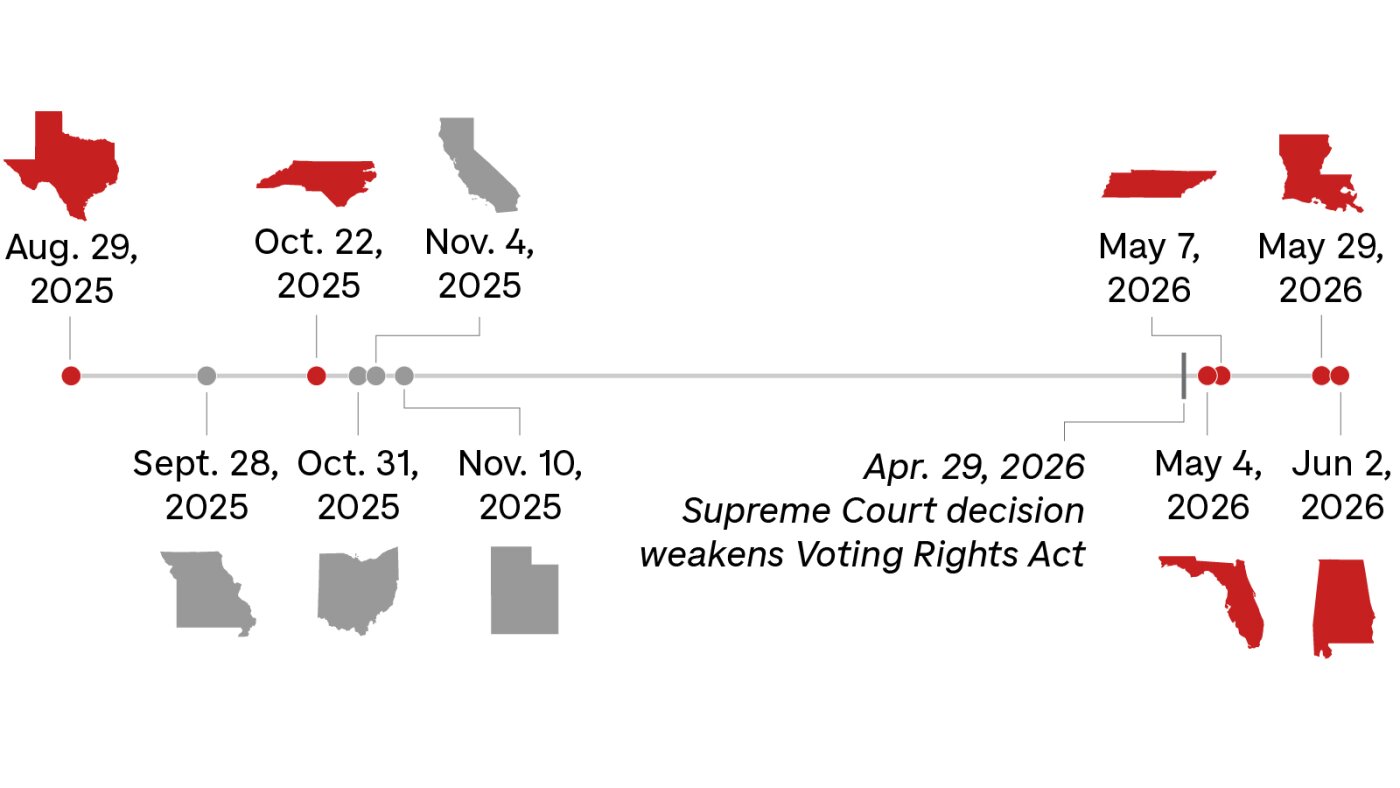
When new congressional maps were enacted for each state, according to Ballotpedia
Rahul Mukherjee/NPR
hide caption
toggle caption
Rahul Mukherjee/NPR
The landscape of congressional districts is changing dramatically in the wake of a contentious Supreme Court decision impacting the Voting Rights Act. This shift, largely prompted by former President Trump’s push for redistricting, has particularly affected majority-Black and plurality-Black districts in states with Republican leadership.
States such as Texas, Florida, Louisiana, Alabama, Tennessee, and North Carolina have redrawn their district maps. This has resulted in Black communities being dispersed into predominantly white districts, a move that has implications for their political representation.
In these areas, voting patterns are largely divided along racial lines, with Black communities often supporting Democratic candidates. For instance, in the 2024 election, nearly 78% of Black voters in these states cast their ballots for Kamala Harris.
Republican officials defend the redistricting as a strategy to strengthen their position in upcoming elections.
Below is an examination of the effects of redistricting on Black communities:
Texas
Prompted by Trump’s call to action, Texas was the first to implement a new congressional map, which favored Republicans by shifting five seats. This change has reduced Black representation in Houston’s congressional districts.
In Houston, Black voters were reorganized, with areas like Sunnyside and Missouri City moving into a newly defined 18th District. This redistricting resulted in a primary battle between Democratic incumbents, with Rep. Al Green losing to Rep. Christian Menefee.
Voting Rights Act Implications
The Supreme Court’s ruling in April declared Louisiana’s map as an unconstitutional racial gerrymander, weakening the Voting Rights Act. This has led to a restructuring of Black-majority districts in several states.
Florida
Florida’s Republicans enacted new districts aiming for a gain of four seats. The 20th District, with its significant Black population, was reworked following the Supreme Court’s guidance. The redrawn district now has a decreased Black population of 45%.
Louisiana
Louisiana’s revisions dissolved one of its Black-majority districts. The former 6th District, which included Shreveport, has been reallocated, shifting Black voters into a Republican-dominated area.
Alabama
Alabama’s map, contested for its discriminatory intent, was reinstated by the Supreme Court. It removes one of the state’s Black-majority districts, dispersing Black voters across less representative areas.
Tennessee
In Tennessee, the only majority-Black district was dismantled, with Memphis divided into multiple districts, reducing the Black population significantly.
North Carolina
North Carolina’s redistricting in 2025 saw the 1st District’s Black population reduced, merging it with predominantly Republican counties.
Methodology
This analysis uses census data from 2020, with previous district maps sourced from the Census Bureau. New maps were obtained from state websites. Each dot on the maps represents 250 people, color-coded by race. Data reflects both Black-alone and Black-in-combination racial categories.