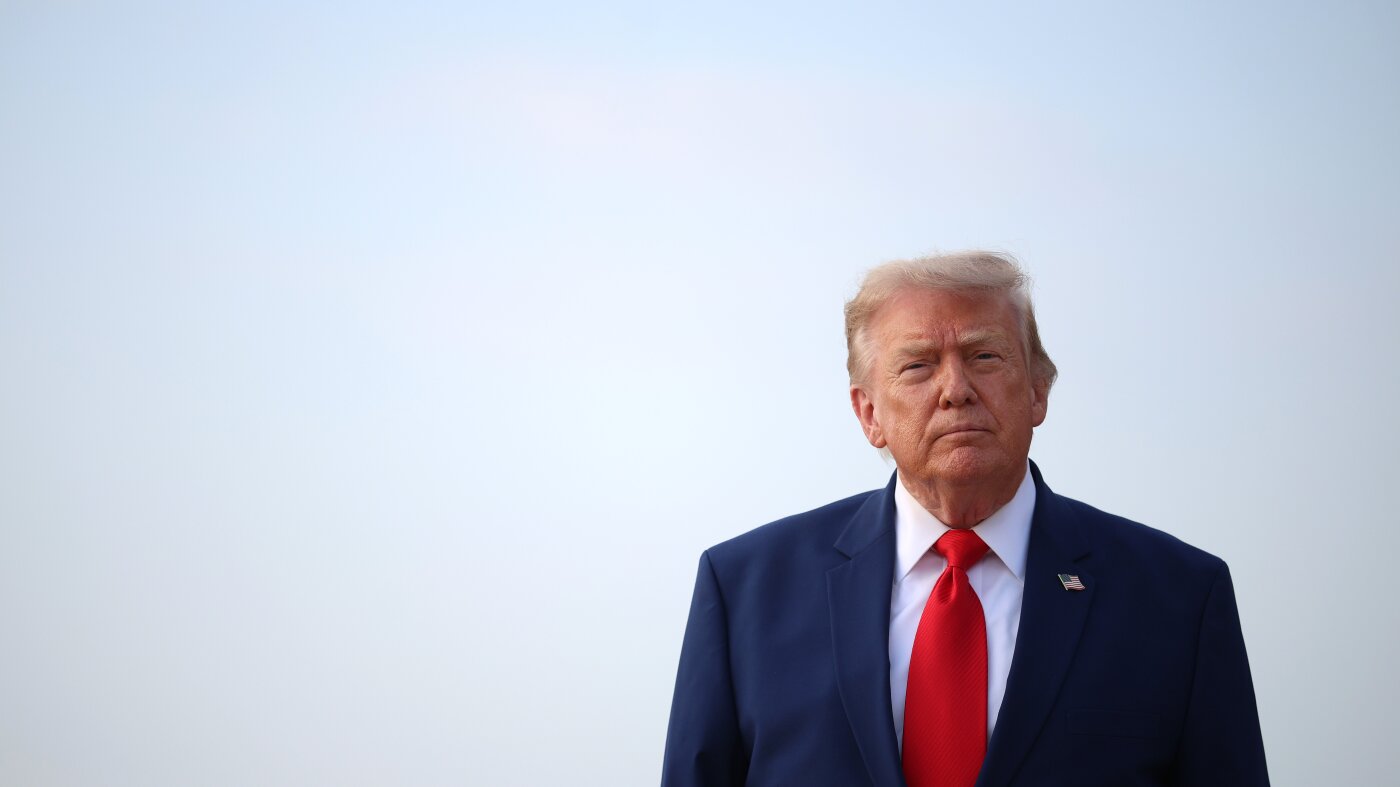
U.S. President Donald Trump looks to reporters after getting off Air Force One on July 22, 2026 at Joint Base Andrews, Maryland.
Kevin Dietsch/Getty Images
hide caption
toggle caption
Kevin Dietsch/Getty Images
In a dramatic turn of events, the Supreme Court’s decision to invalidate many of President Trump’s tariffs has failed to deter him. On the same day as the ruling, the president expressed his resolve to continue imposing tariffs through alternative avenues.
“Other alternatives will now be used to replace the ones that the court incorrectly rejected,” Trump stated during a White House briefing on February 20. “We have alternatives, great alternatives.”
The alternatives refer to different legal frameworks that could be employed to authorize tariffs, after the Supreme Court ruled that the use of the International Emergency Economic Powers Act of 1977 was unlawful for this purpose.
Despite the setback, the administration has shown determination in upholding the president’s tariff policy. Recent actions include the introduction of new tariffs, the levying of fees on Canadian imports, and potential future tariffs on pharmaceuticals. This persistence highlights the administration’s commitment to tariffs, even as public discontent grows over the import taxes.
At 12:01 a.m. Eastern, Friday, a global 10 percent tariff expired. This tariff had been established after the Supreme Court’s decision under a law allowing temporary tariffs to address specific economic issues. In its place, the administration implemented new tariffs on its major trading partners.
The newly introduced tariffs consist of two tiers, 10 and 12.5 percent, targeting goods from 60 of the U.S.’s largest trading partners, including 59 countries and the European Union. These measures are justified by claims of forced labor in the production of imported goods.
While not every country is affected, the scope of these tariffs is extensive, covering over 99% of imports to the U.S., according to the U.S. Trade Representative’s office. However, exemptions exist for certain import categories, such as energy and many types of foods.
A senior administration official, speaking on condition of anonymity, explained that the timing was deliberate to simplify the transition for businesses subject to tariffs. They emphasized the administration’s commitment to ending forced labor.
The administration has taken a firm stance on this issue, criticizing other nations, including allies and major trading partners. According to a U.S. Trade Representative fact sheet, “The United States is the only country in the world to adopt, and effectively enforce, a ban on imports made with forced labor.”
Critics, however, are skeptical about the administration’s motives, suspecting ulterior motives behind the tariff policy. During a recent hearing, Sen. Ron Wyden, D-Oregon, accused the administration of deceit in its trade practices.
“Donald Trump dug up a zombie law to make things even more expensive for Americans,” Wyden asserted. “Trump’s next trade scheme is ordering USTR to reconstruct his illegal global tariffs under the guise of addressing forced labor.”
Alternative Methods
IEEPA provided a swift method for imposing tariffs, but alternative avenues may take longer. The new forced-labor tariffs resulted from a lengthy investigation, and similar processes apply to tariffs on specific goods like aluminum, lumber, and semiconductors.
Nonetheless, Trump has demonstrated his capability for quick action. He recently signed proclamations for 50% tariffs on certain Canadian goods, invoking a 1930 law previously unused for tariffs.
While the president employs new legal justifications, his inclination toward tariffs persists. He has previously threatened tariffs that were never implemented, leaving room for negotiation with Canada under the USMCA agreement.
Earlier this year, the president threatened to sever all trade with Spain over military base disputes, a stance he reiterated recently.
Additionally, proposed pharmaceutical tariffs would not take effect for two years, allowing for potential changes in circumstances or decisions.
The tariffs are being implemented through various statutes, each identified by three-digit numbers like 122, 338, 232, and 301. This creates a complex landscape for importers to navigate.
“It has created a much more complex landscape with all of the three-digits going at once and having to figure out: do they add, how does one fit with the other, what are the exceptions?” said Kathleen Claussen, a trade law specialist at Georgetown Law School. “It is a far more complex landscape, I think, than it was a year ago.”
More to Come?
The administration is conducting a Section 301 investigation involving over a dozen countries and the EU, citing unfair manufacturing practices such as overproduction.
Despite the rollout of new tariffs, polling indicates growing discontent among Americans regarding trade policies, with declining approval for the president’s economic performance.
Yet, Trump remains an advocate of tariffs, often referring to them as his favorite term in speeches. His criticism of free trade agreements and acceptance of protectionist policies were pivotal in his 2016 election success.
Trump believes tariffs aid in negotiating trade concessions from other countries.
His administration argues that tariffs will yield long-term economic benefits, primarily boosting manufacturing.
“The problems the president’s trade policy seeks to solve are generational,” said Trade Ambassador Jamieson Greer. “These things were not broken in the day, and they won’t be fixed overnight. But they must be fixed.”
However, a significant increase in manufacturing employment has yet to materialize, with sector employment still below levels seen at the start of Trump’s presidency.
As Trump seeks voter support for his trade policy, he asks them to weigh its potential future benefits against current dissatisfaction.