
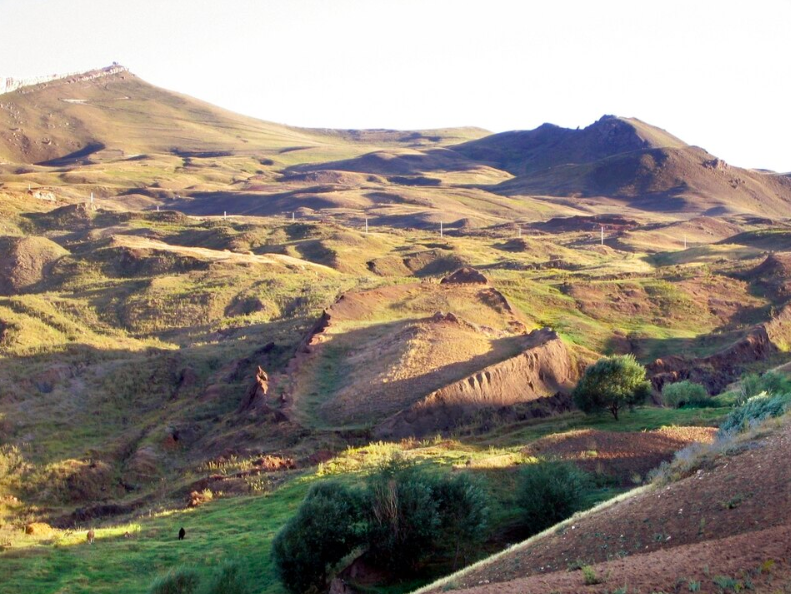
Amid a flurry of media claims about the discovery of pottery fragments in eastern Turkey potentially confirming the existence of Noah’s Ark, a Turkish geographer has called for a measured approach, emphasizing the need for more scientific analysis.
Professor Faruk Kaya, Vice Rector of Ağrı İbrahim Çeçen University, highlighted that although ceramics found near the Durupinar formation might suggest ancient human presence, they do not provide definitive evidence linking the site to the biblical narrative of Noah’s Ark. Kaya, an expert involved in significant archaeological and geomorphological studies, stated that no conclusive proof has been established to back these claims.
The Durupinar formation, a geological structure resembling a boat at Telçeker village in Doğubayazıt, has been a subject of debate since its discovery in 1959, with some proposing it as the resting place of Noah’s Ark as described in Genesis.
Despite claims by media outlets such as GB News, which suggested that an “archaeology discovery could PROVE Noah’s Ark existed,” Kaya warned against drawing premature conclusions. “In the studies carried out so far, no satisfactory information or evidence has been reached,” he stated.
Christian Daily International reached out to Kaya following widespread reports, including one by the Daily Mail, which claimed ceramic fragments near the site “could prove the biblical boat really did exist.”
The New York Post and the Metro echoed these sentiments, while GB News also expanded on the narrative, suggesting an “archaeology discovery could PROVE Noah’s Ark existed after incredible finding.”
Kaya, referencing data shared with the media, noted: “Based on the ceramic fragments observed in the sections opened during road construction works near the geomorphological formation resembling Noah’s Ark, it is considered that there may have been human activity in the region starting from the Chalcolithic Period (approximately 5500–3000 BC).”
These findings led researchers to hypothesize that human activity in the region might have occurred during a time frame close to when Noah is traditionally believed to have lived, according to Kaya.
He further mentioned that while some studies explore the possibility of a ship-like structure at the site, they emphasize the necessity of extensive research, as no tangible archaeological evidence has yet been discovered.
“The ship-shaped formation in Telçeker village of Doğubayazıt attracts great interest because of its proximity to Mount Ararat. However, in order to identify it as the Ark of Noah mentioned in the Bible, information and documentation obtained through scientific and archaeological data are required. I can state that, in the studies carried out so far, no satisfactory information or evidence has been reached,” Kaya said.
© Christian Daily International
This article was originally written by www.christiantoday.com




