
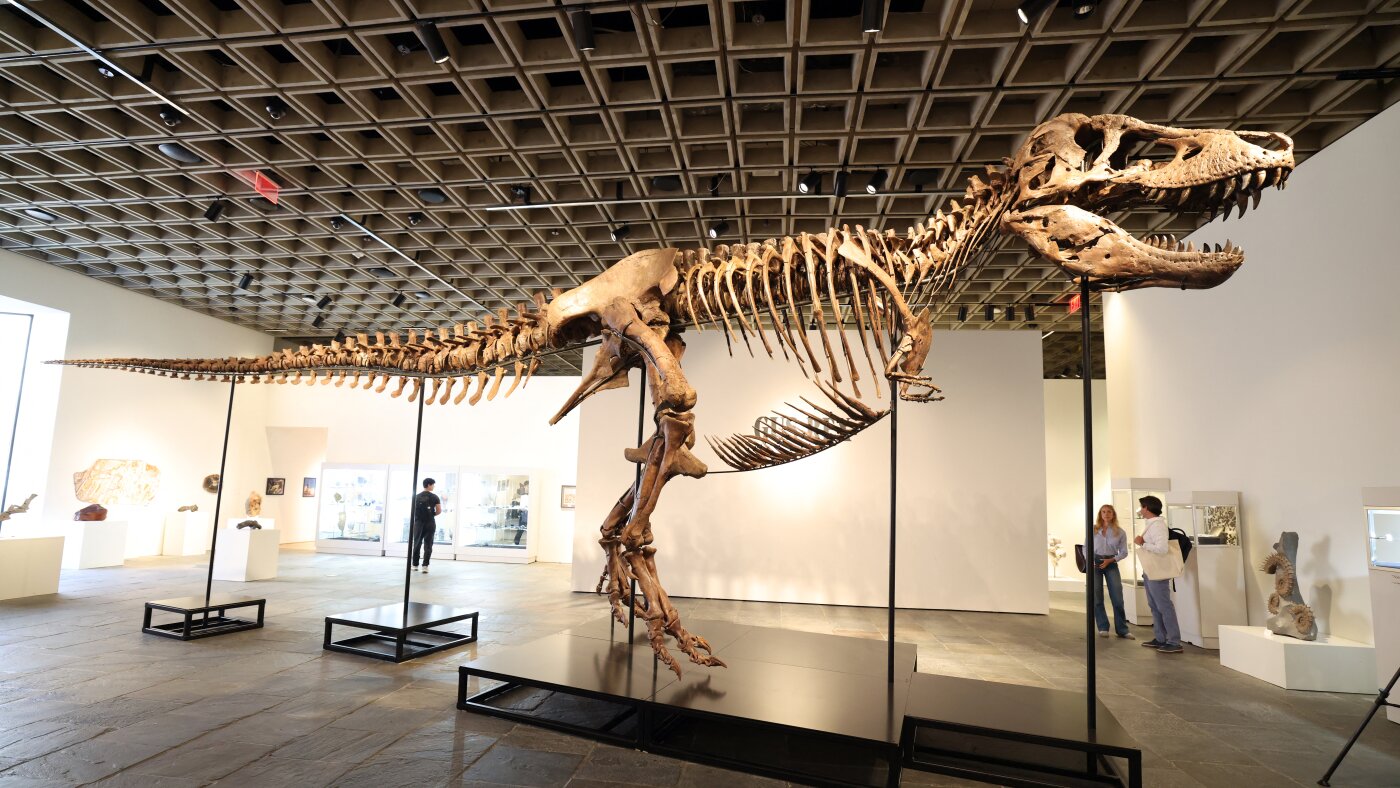
Unique Opportunity: Own a Piece of Prehistoric History with T. Rex Skeleton Auction
Imagine possessing a relic from the age of dinosaurs. This dream can become a reality as a Tyrannosaurus rex skeleton, nicknamed “Gus,” is set to be auctioned in New York City. However, such an extraordinary acquisition comes with a hefty price tag—potentially reaching millions.
On Tuesday morning, Sotheby’s will host the auction of Gus at their New York City office. The starting bid is set at $19 million, with experts estimating a final sale price between $20 million and $30 million.
The fossil was unearthed in 2021 on private land in Harding County, South Dakota. Measuring 38 feet in length and standing 12.5 feet tall, Gus dates back to the late Cretaceous period, approximately 67 million years ago.
An impressive find, Gus is among the most complete and largest T. rex skeletons discovered. “Judging from the overall size and degree of bone development, it can be determined that Gus’ skeleton belonged to a very large, robust, adult individual,” the auction house noted in its listing.
Thomas Heitkamp, president of Theropoda Expeditions, shared in a Sotheby’s video that nearly a thousand pieces were collected during the excavation. The skeleton’s name honors Gary “Gus” Licking, the landowner who discovered the fossil remains. Unfortunately, Gus passed away before witnessing the skeleton’s full assembly.
Cassandra Hatton from Sotheby’s mentioned, “Gary had for years roamed around his 6,500 acre property and seeing T. rex teeth and little bits of fossils and such, and he realized that there was probably something really important under the ground.”
This isn’t the first time a dinosaur skeleton has been offered at auction. In 1997, another T. rex named Sue was sold through Sotheby’s, fetching $8.4 million and eventually becoming part of the Field Museum’s collection in Chicago.
More recently, in 2024, a stegosaurus named Apex was sold for a record-breaking $44.6 million, purchased by Ken Griffin and loaned to the American Natural History Museum for display.
Paleontologist Scott Persons, curator of natural history at the South Carolina State Museum, commented on the growing trend of high-priced dinosaur auctions, attributing it to “an increase in market demand.”
Despite the allure of owning such rare fossils, Persons suggests that buyers could have a more significant impact by funding research. “A sum like that could endow a research program at a public museum of your choosing,” he noted, emphasizing the potential to finance extensive fieldwork and discover new species.
This article was originally written by www.npr.org




