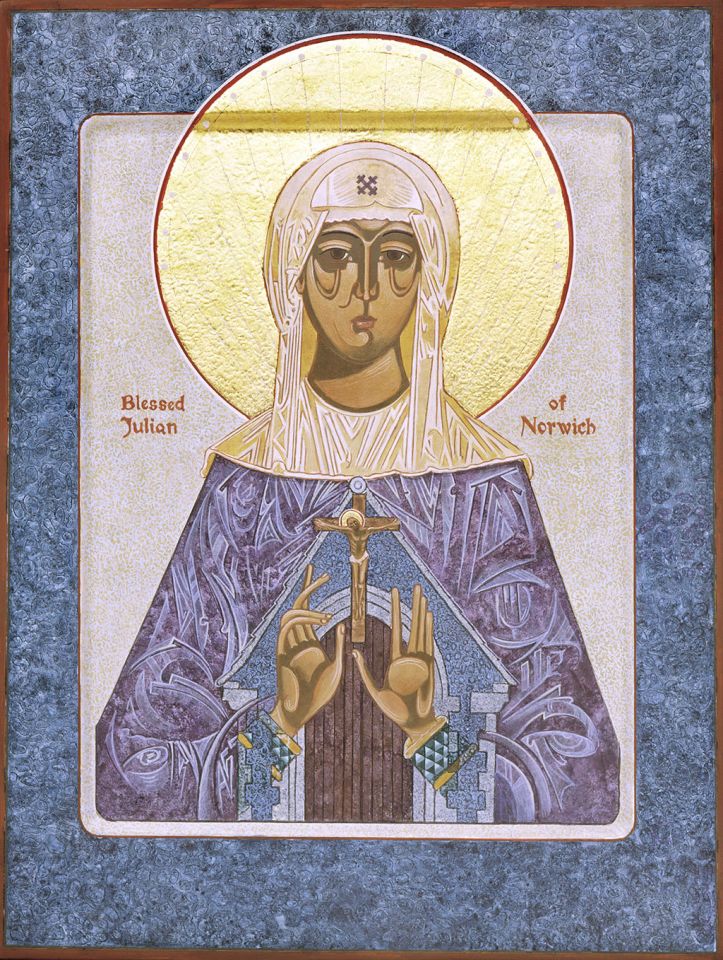
Remembering Julian of Norwich: A Pioneering Woman in Christian Mysticism
(Photo: Julian Centre)
On 8 May, the Christian community commemorates Mother Julian of Norwich, a woman who left an indelible mark on Christian spirituality. Her book, a cornerstone of spiritual literature, is the earliest known English text penned by a woman, offering profound insights into her life and beliefs.
The Life of an Anchorite
In medieval times, anchorites were a unique class of hermits committed to a life of prayer, seclusion, and devotion. Deriving their name from the Greek ‘anachoretes,’ these individuals, often women known as anchoresses, dedicated themselves to living in solitude within a cell attached to a church. The anchorite’s cell, or anchorhold, was a small room with windows for interaction and sustenance, allowing the anchorite to receive communion and converse with visitors.
Julian of Norwich: An Anchoress’s Journey
Julian of Norwich emerged as one such notable anchoress. Born around 1342 in Norwich, she lived through the devastating Black Death. Whether this catastrophe influenced her decision to become an anchoress remains speculative, but her life in solitude began at St Julian’s Church in Norwich, a city rich in religious significance during medieval times.
The Naming of Julian
The name ‘Julian’ might puzzle some, as it is traditionally male. In the Middle Ages, however, it was used for both genders. Mother Julian may have taken her name from St Julian’s Church, where she resided, or it could have been her baptismal name or a religious designation.
Visions and Writings
At age thirty, Julian experienced a near-death illness during which she had a series of spiritual visions, later described as ‘shewings.’ These visions profoundly explored themes such as divine love, the nature of sin, and the human soul’s destiny. Her writings, originally in English, stand as the oldest known book by a woman in the language.
The Revelations
Julian’s visions, expanding over time, delved into the crucifixion of Christ and the encompassing love of God. A famous phrase emerged from these revelations: “All shall be well.” Her exploration of the motherhood of God was groundbreaking, presenting God as both a nurturing mother and a father, enriching Christian theological perspectives.
Legacy and Rediscovery
Though her exact date of death is uncertain, Julian’s legacy endures. Her writings resurfaced in the 17th century, thanks to Hugh Paulinus de Cressy, who published them, bringing renewed interest to her works. Modern editions have since introduced her insights to broader audiences.
St Julian’s Church and Modern Commemorations
Today, St Julian’s Church stands as a testament to her enduring influence. Despite suffering damage during World War II, it was restored, including the reconstruction of her anchorite cell. The Julian Centre nearby serves as a hub for those seeking spiritual reflection.
Celebrating Julian’s Influence
Mother Julian is honored on 8 May, with her contributions recognized across Christian denominations. In recent years, events such as the 650th anniversary of her revelations have celebrated her enduring relevance, especially noted during the COVID lockdowns when many found solace in her writings.
Norwich’s Homage to Julian
In Norwich, her memory is preserved through a statue at the cathedral, the Lady Julian Bridge, and the Julian Study Centre at the University of East Anglia, all commemorating her impact on the city’s history and spiritual heritage.
Anglican Collect for Julian
The Anglican collect for 8 May honors Julian’s legacy:
“Most holy God, the ground of our beseeching,
who through your servant Julian
revealed the wonders of your love:
grant that, as we are created in your nature and restored by your grace,
our wills may be made one with yours,
that we may come to see you face to face
and gaze on you for ever;
through Jesus Christ your Son our Lord,
who is alive and reigns with you,
in the unity of the Holy Spirit,
one God, now and for ever.”
This article was originally written by www.christiantoday.com