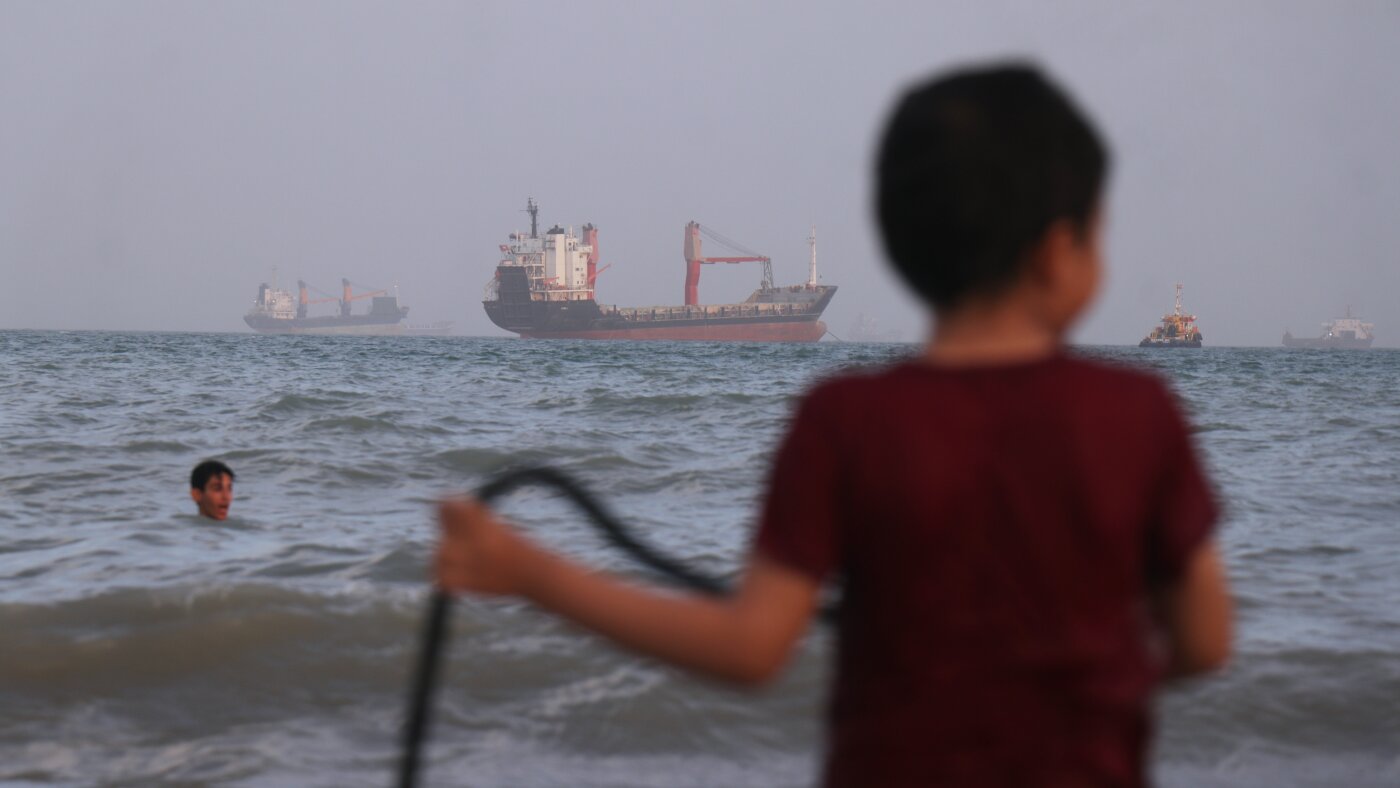
Heightened Tensions in the Strait of Hormuz Amid U.S.-Iran Conflict
The Strait of Hormuz, a vital artery for global trade, has once again become a flashpoint as the U.S. military reports intercepting Iranian attacks on its Navy ships. This comes as a fragile ceasefire between the U.S. and Iran shows signs of strain, raising concerns over the region’s stability.
DUBAI, United Arab Emirates — In a recent development, the U.S. military announced it had thwarted Iranian attempts to target three Navy ships in the Strait of Hormuz. The U.S. Central Command stated via social media that these were “unprovoked Iranian attacks” and that U.S. forces responded in self-defense.
Iranian state media has reported that the country’s forces engaged with “the enemy” on Qeshm Island, the largest island in the Persian Gulf, housing around 150,000 residents and a desalination plant. Additionally, loud noises and defensive fire were noted in western Tehran, while explosions were heard near Bandar Abbas.
In conjunction with these military exchanges, Iran has instituted a new government agency to manage and tax vessels navigating the Strait of Hormuz. This move is generating unease among international shipping entities, as the strait is a critical passage for oil and gas shipments.
U.S.-Iran Ceasefire Under Pressure
Since the ceasefire came into effect on April 8, tensions have fluctuated. Despite ongoing negotiations mediated by Pakistan, the conflict that erupted on February 28 remains unresolved. Iranian Foreign Ministry spokesperson Esmail Baghaei mentioned that Iran is evaluating new U.S. proposals to end the conflict.
U.S. Secretary of State Marco Rubio recently engaged in discussions with Pope Leo XIV at the Vatican regarding Middle East peace efforts. The Vatican has been vocal in its opposition to the ongoing conflict, leading to tensions with President Donald Trump.
President Trump has conveyed mixed signals regarding the conflict, oscillating between threats of further military action and efforts to negotiate peace. A recent attempt by the U.S. to secure safe passage for commercial ships was halted to facilitate ongoing peace talks.
Iran’s New Regulatory Measures in the Strait
Lloyd’s List Intelligence reported that Iran’s newly formed Persian Gulf Strait Authority is now responsible for granting passage permissions and collecting tolls from ships in the strait. This regulatory change has sparked international debate over the right to free navigation, as outlined by the United Nations Convention on the Law of the Sea.
Efforts are underway by the U.S. and its Gulf allies to push for a U.N. Security Council resolution condemning Iran’s control over the strait. Previous attempts were blocked by vetoes from Iran’s allies, Russia and China.
Diplomatic Efforts and Regional Reactions
Pakistani Foreign Minister Ishaq Dar communicated with Iran’s Abbas Araghchi, expressing optimism for a forthcoming agreement. Meanwhile, direct discussions between Israel and Lebanon are set to resume in Washington, indicating a broader regional push for stability.
While Iran’s Supreme Leader Mojtaba Khamenei has been instrumental in negotiations, he remains out of public view following injuries sustained earlier in the conflict. President Masoud Pezeshkian recently met with Khamenei, describing the meeting as sincere.
Additionally, a Saudi official disclosed that Saudi Arabia did not support the U.S. initiative to reopen the strait, emphasizing that there would be no involvement in related U.S. military actions. This reflects the complex geopolitical dynamics at play in the region.
This article was originally written by www.npr.org