Trump’s Proposed Arch Near D.C. Airport Raises Safety Concerns
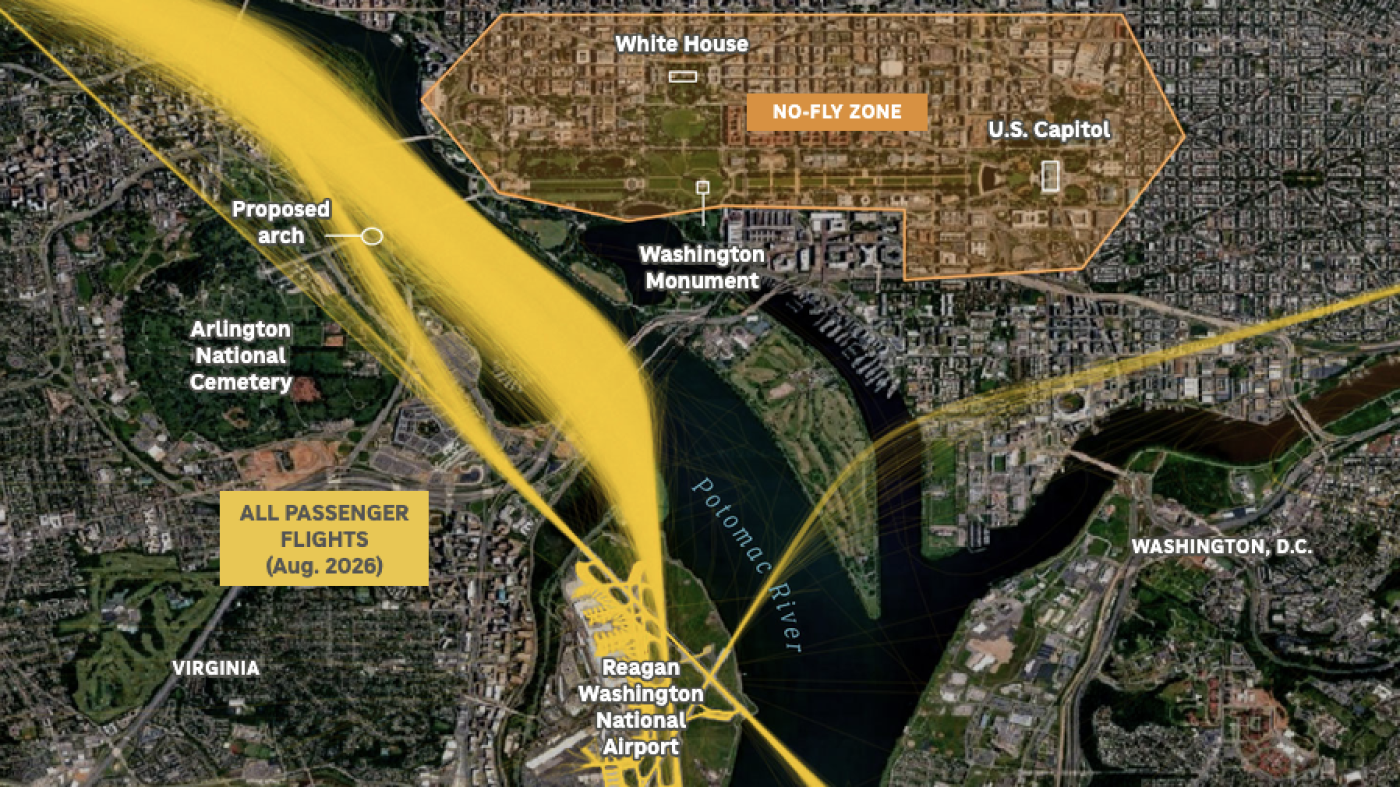
The Trump administration’s plan to erect a 250-foot arch at Memorial Circle has sparked a heated debate, focusing on its potential impact on aviation safety. Situated close to Ronald Reagan Washington National Airport, this project has garnered attention due to its proximity to one of the nation’s busiest runways.
The administration insists that the arch will not introduce additional hazards. Yet, a Federal Aviation Administration (FAA) preliminary report suggests the need for red obstruction lights, akin to those on the Washington Monument, to ensure it does not interfere with flight paths. Further analysis by the FAA is ongoing, with no clear timeline for completion or findings shared with the public.
Aviation safety experts agree that while the arch itself might not pose a significant risk to aircraft, it could complicate operations in an already dense and complex airspace. U.S. Rep. Don Beyer expressed concerns about the potential for disaster, given the frequency of flights over the proposed site. “Just imagine the disaster that could happen with all of these airplanes coming right across a 250-foot-high arch,” he told NPR.
The congested airspace around D.C.’s airport is a well-known issue, exacerbated by a 2025 midair collision that resulted in 67 fatalities. This incident highlighted ongoing safety challenges and led to rule changes. Despite this, some fear political pressure might influence the FAA’s decision-making regarding the arch.
Critics argue against the arch’s construction, citing potential disruptions to Arlington National Cemetery and other historic sites, as well as questioning its scale and financial implications. The Trump administration maintains that it would be a tribute for the nation’s 250th anniversary.
Experts like Jeff Guzzetti, a former accident investigator, warn that the arch adds another variable to the airspace. “It’s a small airport with one runway, nestled in a metropolitan area that’s surrounded by prohibited airspace,” he said. The arch’s presence could further strain air traffic controllers already managing high traffic density.
D.C.’s Airspace Complexity
Washington’s airport is federally owned, with Congress regulating flight numbers. Originally designed for 15 million passengers annually, it now serves closer to 25 million, placing additional stress on air traffic controllers. Tom Lintner, an aviation safety expert, noted that increased traffic reduces the margin for error, with controllers making decisions every few seconds.
Recent events underscore the airspace’s challenges, such as a close call involving a military helicopter carrying President Trump. These incidents highlight the airspace’s complexity, even without the proposed arch.
Proximity and Risks
Experts are particularly concerned about the arch’s impact on landing aircraft. The approach to Runway 19, known as the “River Visual,” requires pilots to make sharp turns at low altitudes, creating a challenging environment. The arch could exacerbate these difficulties, especially in adverse weather conditions.
While the FAA’s ongoing study will determine if the arch poses a hazard, its conclusions are not legally binding. The administration could potentially override any findings with a waiver.
As debates continue, the administration plans to proceed with preliminary work at the site. The project’s future depends on various approvals, including from the National Capital Planning Commission.
This article was originally written by www.npr.org