The Evolving Role of the British Monarchy in a Diverse Society
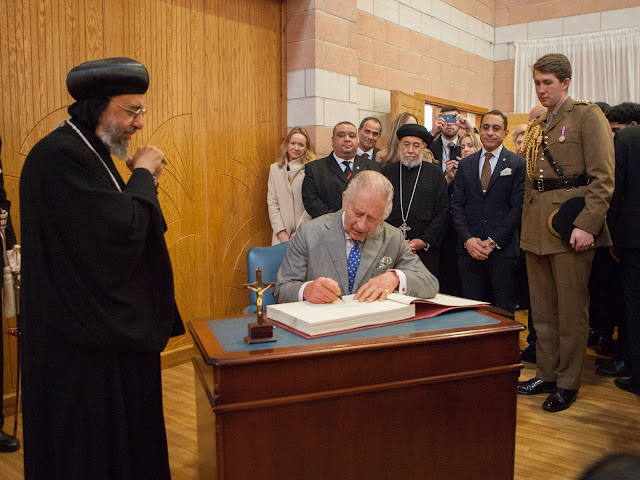
(Photo: The Coptic Orthodox Church Centre UK)
As the British monarchy adapts to modern societal changes, a noteworthy shift has emerged in the description of the sovereign’s role. The focus has transitioned from defining the monarch solely as the Supreme Governor of the Church of England and Defender of the Faith to emphasizing the protection of “the space for faith within the multi-faith nation.”
This adjustment reflects King Charles’ commitment to promoting religious freedom, mutual respect, and peaceful coexistence, ideals that resonate in a multicultural society. The importance of defending every individual’s right to believe, worship, or not believe without fear or coercion is underscored in this approach.
However, a critical distinction remains between the roles of the State and the Church. The State is tasked with safeguarding religious freedom, while the Church’s mission is to proclaim the gospel’s truth.
While the king may advocate for the freedom of all faiths, the Church maintains a unique perspective, aligned with Jesus’ declaration: “I am the way, the truth, and the life. No one comes to the Father except through me.” This underscores Christianity’s assertion that it is not merely one path among many, but the announcement of divine intervention through Christ.
The Church’s purpose extends beyond preserving religious space; it is to offer the message of saving grace and guide individuals towards Jesus Christ with love and faithfulness.
Throughout history, earthly monarchs have ruled temporarily, but the Christian faith proclaims an eternal King. While physical crowns are inherited, the crown of Christ was initially one of thorns, signaling a kingdom that stands unshaken despite the rise and fall of earthly realms.
The British Crown acknowledges this enduring truth. During the Coronation, the sovereign is anointed under God’s authority, illustrating that the monarch governs by divine permission and remains answerable to God.
Christians are thus encouraged to honor the king, pray for him, and support the nation’s well-being under his rule, as instructed by Scripture. Yet, their ultimate allegiance is to Christ alone.
The Church is most effective when it serves the King who wore a crown of thorns before receiving the crown of glory. In defending religious freedom for all, the Church must not lose sight of its supreme calling: to proclaim the name that is above every other.
For when all earthly thrones have fallen and crowns have been set aside, one King of kings will remain, and his name is Jesus.
Canon J.John is the Director of Philo Trust. Visit his website at www.canonjjohn.com or follow him on Facebook, Instagram or Twitter.
This article was originally written by www.christiantoday.com