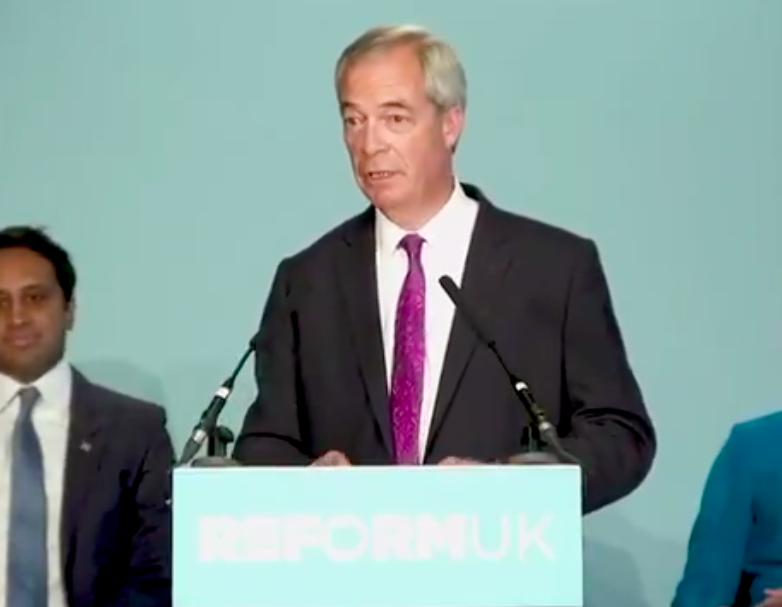
Could the political landscape in Britain become more favorable to Christians under a Reform government? According to James Orr, a key member of the party, Nigel Farage’s leadership might just offer that promise. He asserts that Farage’s commitment to these values is genuine, not merely rhetoric.
James Orr, who serves as Reform UK’s head of policy and is also a philosopher and theologian, shared these thoughts in an interview with The Telegraph.
The idea of Nigel Farage as a potential prime minister evokes mixed emotions. While some supporters are hopeful, opponents are wary. Despite a dip in support over the past six months, Reform UK continues to lead in opinion polls.
Nigel Farage has described himself as a member of the Church of England, although he admits to not attending regularly and often disagrees with church leadership.
Orr elaborated on Farage’s faith, saying, “He’s got a kind of grounded Christianity … His fondness for Christianity, or Judeo-Christianity as he calls it, comes from a sense that it belongs to the nation that he loves.”
During the interview, Tim Stanley of The Telegraph, who is Catholic, compared this brand of Christianity to “English Shinto,” a term used to describe a religious sentiment akin to the cult surrounding the Japanese Emperor.
The phrase “English Shinto” has been associated with historian David Starkey, an atheist and ally of Farage. Starkey has praised the Church of England as a unifying national force despite being a member of the Conservative Party.
Starkey remarked in a 2012 interview with the Guardian that before Michael Ramsey’s tenure as Archbishop of Canterbury began in 1961, “the archbishops had been the high priests of English Shinto: in other words, the church’s job was really just to [enable us to] worship the monarchy and, by extension, ourselves. That was sensible. But then it gets cluttered up with all this nonsense about Christianity.”
Orr, whose spouse is a vicar, echoed sentiments similar to Farage’s past statements regarding his own Anglican practice, saying, “[I’m] hanging on by my fingernails. Imperfectly practising. I practise when I can … It’s very difficult for me to go to church on a Sunday.”
He further mentioned that while he hasn’t discussed religion directly with Farage, the Reform party would be more accommodating to Christians compared to other political parties.
Orr emphasized that Farage’s connection to Christianity is sincere, stating, “He really believes it,” and noted Farage’s disappointment with what he perceives as the Church of England’s progressive shift.
This article was originally written by www.christiantoday.com