
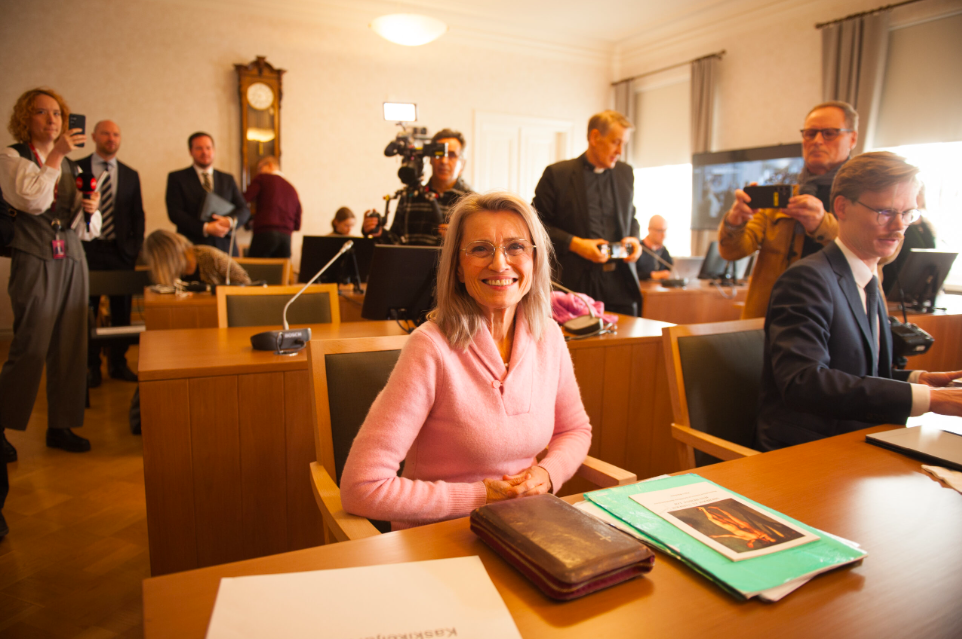
Controversial Conviction of Finnish MP Sparks Global Debate on Free Speech
In a decision that has reverberated across the globe, Finnish MP Päivi Räsänen and Lutheran bishop Juhana Pohjola were convicted by Finland’s Supreme Court for incitement against a minority group. The basis of this ruling was a 2004 pamphlet titled Male and Female He Created Them – Homosexual Relationships Challenge the Christian Concept of Humanity, which both parties were involved in publishing.
The prosecution, which began in 2019, has drawn significant attention as a potential infringement on freedom of speech. According to a statement from the Alliance Defending Freedom (ADF), a Christian legal organization supporting Räsänen, “Across the world, freedom of speech is recognized as one of the most fundamental human rights. All major human rights treaties protect this freedom, and every democratic society is reliant on the ability of its citizens to speak freely.”
Despite being exonerated twice by lower courts, Räsänen was ultimately found guilty by a narrow 3-2 decision. While her acquittals for a tweet about same-sex marriage and a radio debate comment were upheld, the court ruled against her regarding the pamphlet. ADF expressed concern, stating, “While it is right and just that these two acquittals stand, the conviction for publishing a decades-old pamphlet marks a dark day for freedom of expression.”
The crux of the Supreme Court’s decision lies in the pamphlet’s content, which, according to the court, presented homosexuality as a “disorder of psychosexual development,” a claim deemed scientifically incorrect based on a 2020 expert opinion from the National Institute for Health and Welfare. The court’s judgment underscored that “homosexuality is considered to be part of the normal spectrum of sexuality” and not a disorder.
The judgment further noted that Räsänen’s statements could perpetuate negative stereotypes and discrimination against homosexuals, contributing to psychological harm. This led to the conclusion that her statements, being “incorrect and insulting,” warranted legal action despite her rights to freedom of expression and religion.
This case highlights three prevailing ideas in Western societies: the authority of science as the ultimate truth, the role of designated scientific bodies as arbiters of this truth, and the notion that harmful speech can be criminalized, even if it causes no direct physical harm. These concepts have sparked debate about their implications for free speech and scientific discourse.
Critics argue that these ideas undermine the principle that truth should not be censored, and that scientific inquiry thrives on the freedom to challenge prevailing ideas. They warn against a “victim-centered authoritarianism” that stifles dissent under the guise of protecting vulnerable groups, as articulated by Carl Trueman in his book Strange New World. Trueman notes, “Freedom of speech and academic freedom are simply licenses to oppress and marginalize the weak.”
The conviction of Räsänen serves as a focal point for ongoing discussions about the balance between protecting minority groups from harmful rhetoric and upholding the fundamental right to free speech in democratic societies.
This article was originally written by www.christiantoday.com




