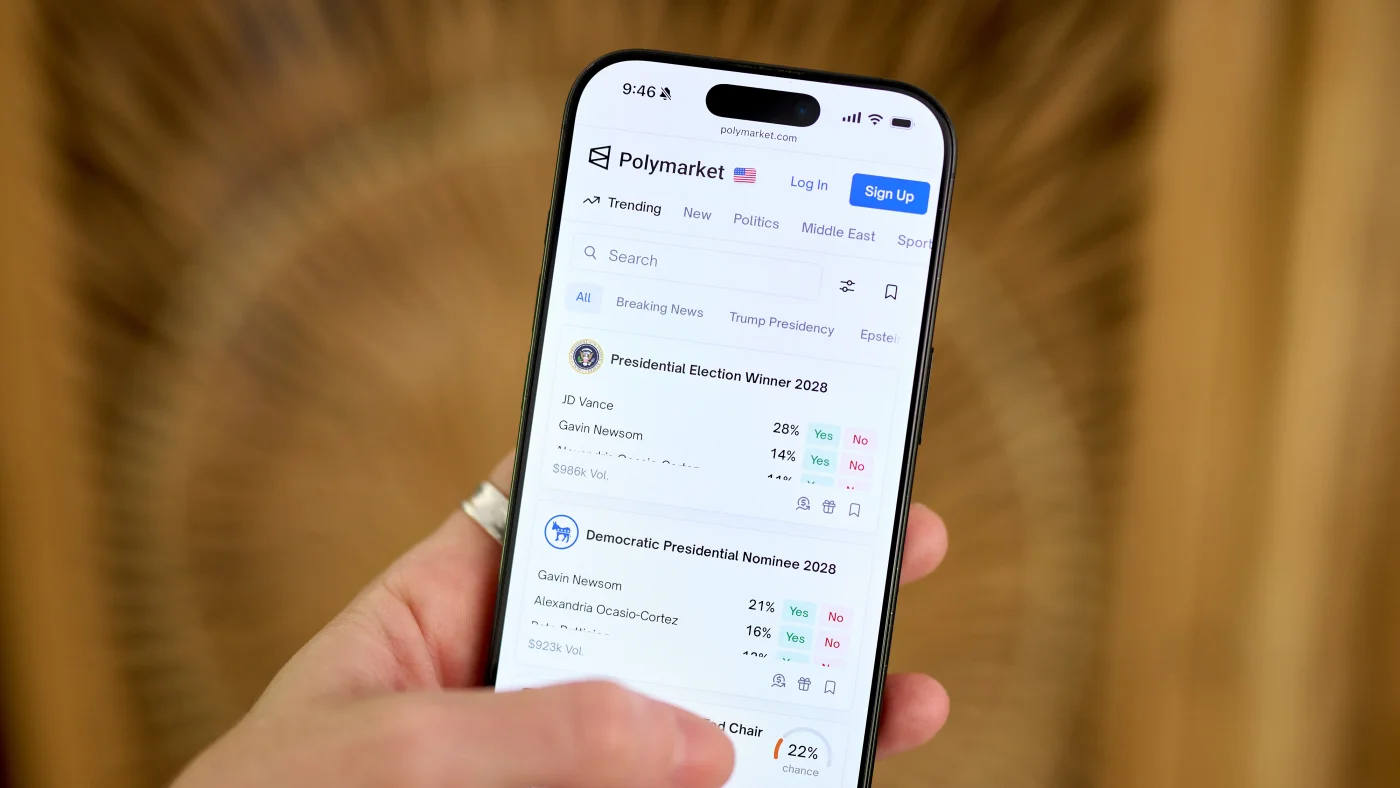
Rising Popularity and Regulatory Challenges in Election Prediction Markets
In the fast-evolving world of prediction markets, platforms like Polymarket and Kalshi are experiencing significant growth, particularly during President Trump’s second term. However, this surge in interest brings with it legal challenges and concerns about the potential impact on democratic processes.
Prediction markets, like Polymarket and its main rival, Kalshi, have flourished in Trump’s second term. Gabby Jones/AFP via Getty Images
Polymarket’s head of global intelligence, Shana Bautista, revealed that the platform has been investigating “dozens” of bets connected to the midterm elections. Two of these cases have been escalated to the U.S. Commodity Futures Trading Commission (CFTC) for further review. The growing scrutiny highlights the tension between the popularity of platforms like Polymarket and Kalshi and the legal hurdles they face.
In April, Kalshi took action by banning and fining political candidates who bet on their own races. Meanwhile, reports surfaced in May indicating that campaign staffers leveraged insider information to profit on platforms such as Polymarket and PredictIt.
Shana Bautista, who joined Polymarket in June, oversees a team dedicated to monitoring election-related wagering. Her background as a former FBI official and cryptocurrency analyst aids in the surveillance efforts. She emphasized the illegality of trading based on confidential information, stating, “If you have information that you have a duty to protect, don’t trade on it. It’s explicitly against our terms of use on both platforms, but also is against the law.”
Polymarket’s surveillance system aggregates data from various sources, including social media and Federal Election Commission (FEC) data, to monitor user activities. If suspicious behavior triggers certain red flags, Bautista receives immediate alerts, sometimes numbering in the hundreds daily.
Kalshi, Polymarket’s primary competitor, has also implemented an election surveillance system, blocking FEC-listed campaign staffers from participating in election bets. Despite these measures, some staffers have reportedly circumvented the restrictions, as revealed in interviews with NPR.
The susceptibility of election prediction markets to manipulation is a concern for experts like Rajiv Sethi, an economics professor at Columbia University. He warns that these markets can become “self-fulfilling prophecies” if public perception begins to influence actual election outcomes.
As the prediction market industry continues to expand, the CFTC’s involvement remains limited, often leaving regulatory responsibilities to the companies themselves. This hands-off approach places significant pressure on platforms like Polymarket and Kalshi to self-regulate effectively.