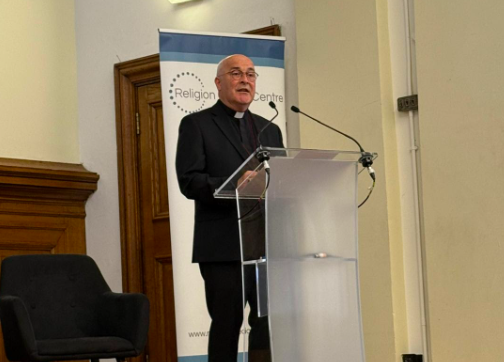
Archbishop of York Highlights the Essential Role of Religion in Modern Media
In a compelling address at the Religion Media Festival, the Archbishop of York, Stephen Cottrell, emphasized the critical importance of religious literacy for understanding both global events and local communities in Britain. He urged media outlets to more accurately represent faith, cautioning that ignoring religion undermines the public’s ability to interpret contemporary issues and history.
Speaking on the theme ‘Protecting the place of religion in the media in a digital age’, Archbishop Cottrell stressed that religion should not be relegated to a niche subject but recognized as a core element of public life. He argued that improved religious literacy could break down stereotypes, enhance community cohesion, and restore trust in public institutions.
“Representation in the media matters because faith matters, because values matter, but also to demystify and familiarise those who have no religious affiliation, so that everyone, of whatever faith or none, can see themselves represented and that faith can be understood, represented and explained,” he stated.
The Archbishop highlighted that a sound understanding of religion is vital for interpreting Britain’s culture, literature, legal traditions, and international conflicts. He noted that religious literacy helps individuals engage more knowledgeably, reducing reliance on assumptions or prejudices and fostering stronger relationships in diverse communities.
Cottrell expressed concern over the decline of specialist religious journalism, which has resulted in less comprehensive coverage of religious aspects in major world events. He cited conflicts in the Middle East and Ukraine as instances where religious and historical contexts are essential for full comprehension.
The lack of adequate media coverage, he argued, perpetuates stereotypes and misconceptions, potentially leading to hostility against religious communities and reinforcing false narratives prevalent online.
Additionally, Archbishop Cottrell pointed to a broader crisis of public trust in the media, which has seen a significant decline over the past decade. He suggested that trust can be rebuilt by ensuring people feel represented and included, particularly in a digital media landscape prone to misinformation and echo chambers.
Defending the role of public service broadcasting, he emphasized its importance in educating the public about societal beliefs, values, and traditions. He noted, “The values are not an ‘add on’ or a ‘take away’ but arise from and are held by the narratives, beliefs and practices which make up the Christian life.”
Archbishop Cottrell advocated for greater media attention to Britain’s diverse religious communities, suggesting that faith’s role in national life should be highlighted beyond traditional religious programming. During his Lord’s Prayer tour in northern England, he observed the necessity of publicly explaining the Christian faith to enhance understanding of Britain’s historical and cultural development.
He praised religious programming like the BBC’s recent series on pilgrimage for promoting understanding of religious diversity. National events such as Remembrance services and royal ceremonies, he argued, contain significant religious elements that require explanation for modern audiences.
While acknowledging that digital platforms allow faith communities to communicate directly with the public, Archbishop Cottrell warned about the potential for these platforms to spread misinformation and foster polarizing debates. He called for stronger regulation of digital spaces, emphasizing that the ethical oversight of emerging technologies is crucial.
Concluding his address, he remarked, “Therefore, in supporting the continuation of the public service broadcasting sector I don’t so much want to ask the questions whether, for instance, is the licence fee is value for money, but whether public service broadcasting in all its different forms, gives us ‘values for money’ – and that the promotion of those values includes and understands the value of faith and the values that come from faith, helping us to understand the world; to understand each other; to understand ourselves and building a kinder and more coherent society.”
This article was originally written by www.christiantoday.com