Special Education Teachers Turn to AI for Efficiency
In an era where special education teachers are stretched thin, AI technology is emerging as a significant ally, particularly in the realm of paperwork management. Mary Acebu, a special education teacher at Riverview Middle School in Bay Point, California, has experienced a profound transformation in her daily routine thanks to these advancements.
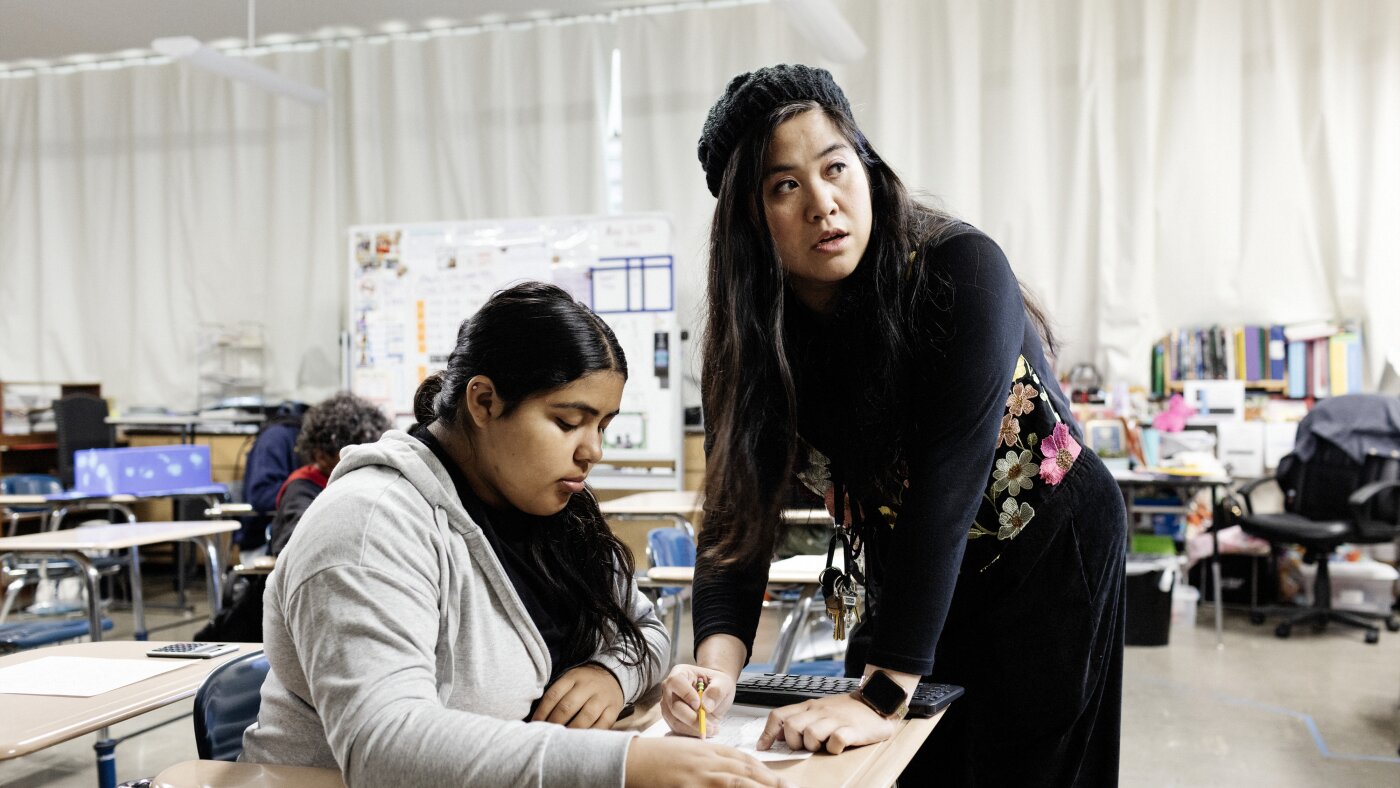
Mary Acebu, a special education teacher at Riverview Middle School in Bay Point, Calif., works with a student during a math lesson. She says using AI to help with the paperwork part of her job allows her to spend more time interacting with her students in a meaningful way. Talia Herman for NPR
Editor’s note: NPR uses only the first names of minors in this story because it discusses their learning disabilities and placement in special education.
The long hours and extensive paperwork that once defined Acebu’s career are now a thing of the past. “I don’t do that anymore,” she acknowledges with a laugh, crediting AI with transforming her daily schedule. With AI handling much of the paperwork, Acebu finds herself with more time to engage with her students, fostering meaningful relationships and enhancing their educational experiences.
The issue of hiring and retaining special education teachers is a nationwide challenge. In the 2024-25 school year, 45 states reported shortages in this crucial educational sector. A significant factor contributing to teacher burnout is the overwhelming amount of legally mandated paperwork. Acebu, like many of her peers, has turned to AI to expedite the creation of Individualized Education Programs (IEPs), essential documents that outline student goals and services.
According to the Center for Democracy and Technology, 57% of special education teachers used AI in the 2024-25 school year to help develop these plans, up from 39% the previous year. While AI offers efficiency, the CDT warns of potential privacy, legal, and ethical risks.
Research from the University of Virginia and the University of Central Florida suggests that AI, when used appropriately, can produce IEPs of equal or higher quality than those crafted solely by teachers. This efficiency allows educators more time for direct student interaction, which, as Olivia Coleman of UCF notes, “often yields better outcomes for them, both educationally [and] functionally.”
Acebu’s classroom is a testament to this. King, one of her eighth-grade students, progressed from being a non-reader to reading confidently. This achievement, Acebu believes, underscores the real purpose of IEPs: to implement what’s on paper into practice.
Understanding IEPs and Their Importance
IEPs are individualized documents required by federal law for over 8 million students with disabilities in the U.S. These plans outline annual goals tailored to each student’s unique needs. Teachers, like Acebu, spend significant time understanding each student’s learning style to develop these plans effectively.

Mary Acebu has been a special education teacher for a decade at Riverview Middle School. She is part of a task force that is working on an AI policy for her school district. Talia Herman for NPR
Despite the workload, teachers recognize the necessity of IEPs in providing quality education to students with disabilities. Acebu notes the importance of understanding each student’s learning style, emphasizing that the process is deeply individualized.
Integrating AI with a Human Element
Acebu’s journey with AI began with courses on its safe and effective use. Her district, Mt. Diablo Unified, has agreements with companies providing education-focused AI tools that promise to protect student data. With AI’s assistance, Acebu customizes chatbots to handle tasks from creating personalized worksheets to developing IEP goals, always ensuring a human touch in the final product.

King, an eighth grader, went from not being able to read to reading confidently since he joined Acebu’s class last year. She says that has been possible, in part, because AI has given her more time to work directly with students in the classroom and less on paperwork. Talia Herman for NPR
Research by Coleman and Waterfield found that special education teachers are using AI to write IEP goals, track progress, and create learning materials. Acebu, who recently earned a doctorate in instructional technology, is part of her district’s AI task force, developing policies to ensure AI is used effectively and ethically.
While some educators, like Paul Stone, initially viewed AI with skepticism, the increasing workload has led them to embrace its benefits. Stone, who now uses AI to streamline his work, acknowledges the importance of reviewing AI outputs to ensure quality.
Ensuring Safe AI Use in Special Education
As AI becomes more prevalent in education, concerns about privacy and bias remain. Educators are urged to use district-approved tools and maintain a human presence in the process. Despite these challenges, Acebu finds that AI tools have significantly improved her work-life balance, allowing for more direct student engagement and success stories like King’s.
Edited by: Nirvi Shah
Visual design and development by: LA Johnson