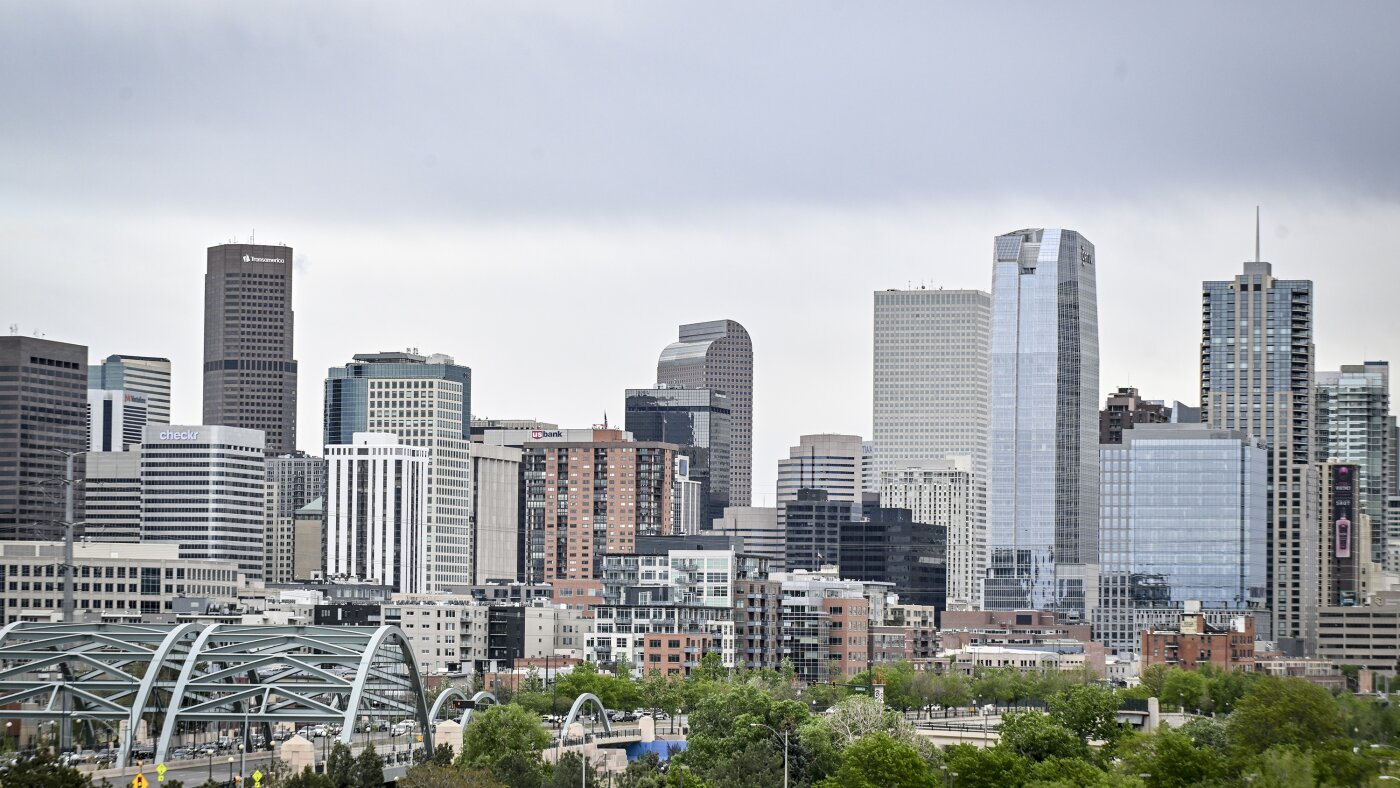
Denver plans to heat and cool a cluster of downtown buildings with a system using water, geothermal energy and even heat from … sewage.
Aaron Ontiveroz/Denver Post via Getty Images
hide caption
toggle caption
Aaron Ontiveroz/Denver Post via Getty Images
NPR is dedicating a week to stories and conversations about how communities are moving forward on climate solutions despite significant political headwinds. As the federal government halts plans to address climate change, states, cities, regions, and even neighborhoods are trying to fill the gap by cutting climate pollution and adapting to extreme weather.
DENVER — Like many American cities, the largest source of climate pollution in Denver is its buildings. Operating the city’s skyscrapers requires extensive use of fossil fuels.
In response, Denver is turning to a more sustainable solution. The city aims to use a combination of water, geothermal energy, and sewage to heat and cool a collection of large downtown buildings.
The Cherokee Boiler House, located near downtown, will serve as the heart of this initiative. Although its brick exterior is appealing, the inside is dominated by rattling pipes and hazard signs.
“It looks like a good place for a rave or potentially a horror movie,” says Denver Mayor Mike Johnston.
However, city officials believe this facility could be pivotal in helping Denver achieve its goal of reducing greenhouse gas emissions to zero by 2040, while also saving taxpayer money.
“We think we are standing in what can be the future of energy in Denver, which is both pollution free and affordable,” Johnston says.
Denver’s new approach involves piloting a thermal energy network. Similar networks have been implemented on campuses and in other cities globally. If successful, it could set a precedent for decarbonizing dense downtown areas across the U.S.
From Steam System to an “Ambient Loop”
Currently, over a hundred buildings in downtown Denver rely on the world’s oldest continuously operating commercial steam system, which uses natural gas, a fossil fuel.
Originally built in the late 1800s, the steam network was once hailed as a marvel by newspapers. Today, it is leaky and inefficient.
Steam bills for customers have more than doubled over the past decade due to maintenance costs, fossil fuel prices, and a declining customer base.
A 2021 city ordinance mandates large buildings to cut greenhouse gas emissions or face penalties in the future. However, meeting these targets may be unfeasible for those still using the outdated steam system.
Over the next decade, Denver plans to transform parts of its old systems into a new heating and cooling network for 11 city-owned buildings, forming an “ambient loop.”
This new system will utilize underground pipes filled with water, circulating among buildings like a lazy river, hence the name “ambient” due to the water’s tepid temperature.
Each building will have water-source heat pumps, which are highly efficient appliances that can transfer energy from the circulating water to either heat or cool the building.
“Basically, heat pumps can move heat wherever you need it,” says Elizabeth Babcock, head of Denver’s Office of Climate Action, Sustainability, and Resiliency.
If a building overheats, heat pumps will extract heat from the air and release it into the circulating water. Conversely, if a building is too cold, the pumps will draw heat from the water to warm the interior.
Since buildings are interconnected, they can share energy. For example, if the art museum is overheated, its excess heat can be transferred to another building in need.
The Cherokee Boiler House will eventually manage the loop, serving as the system’s “brains and brawn,” according to Drew Halpern from the city’s climate office.
Tapping the Heat Beneath Denver’s Feet
The city will begin with a few buildings. As more join, the loop will require additional energy to maintain the water’s temperature. Denver plans to tap into the Earth’s geothermal heat, a nearly unlimited clean energy source.
Under downtown parking lots, the city will drill geothermal boreholes to tap energy from over 1,000 feet underground.
These boreholes will act as a battery for the network, exchanging energy with the Earth, then channelling it to buildings on the loop.
Geothermal heat is virtually free after installation, although drilling boreholes is costly.
Denver also aims to utilize an unconventional source of “clean” energy: sewage.
Denver’s Secret Sauce: Sewage
Dan Freedman, director of technology and innovation at Metro Water Recovery, explains that sewage is not typically seen as an energy source.
Activities like showering and doing laundry produce warm wastewater rich in thermal energy.
“If we’re being honest, geothermal just sounds sexier than wastewater thermal,” Freedman said during a tour of Metro’s treatment facility in Denver.
Currently, Denver’s wastewater, still warm, is treated and released into the South Platte River, which is not ideal for the river’s health. To comply with future state regulations, Metro will need to cool it.
Wastewater can hold about four times the heat used by buildings on the steam system during winter, according to Freedman.
Denver plans to install a heat exchanger in a major sewage line to extract some of this heat for the loop, saving on cooling costs and energy.
The city’s most extensive “sewer heat recovery” system currently exists at a large complex in Denver. Implementing this on a city scale could lead to wider adoption.
“If successful, I’m incredibly confident that it’s just gonna take off,” Freedman says.
A Model for Other Downtowns?
Denver’s initiative will start small, with two buildings and a sidewalk snowmelt system piloting a micro version of the loop in about two years. By 2030, nine buildings are expected to be connected.
Mayor Johnston is optimistic that if the pilot succeeds, it can be adapted for thousands of natural gas customers downtown, speeding up the city’s emission reduction efforts.
“If you can come to one of the most bustling, vibrant downtowns in the world and discover any one of those buildings is heated and cooled by water,” he says, “that is a breakthrough for the city and, I think, a breakthrough for the country.”
Edited by Rachel Waldholz
This article was originally written by www.npr.org