
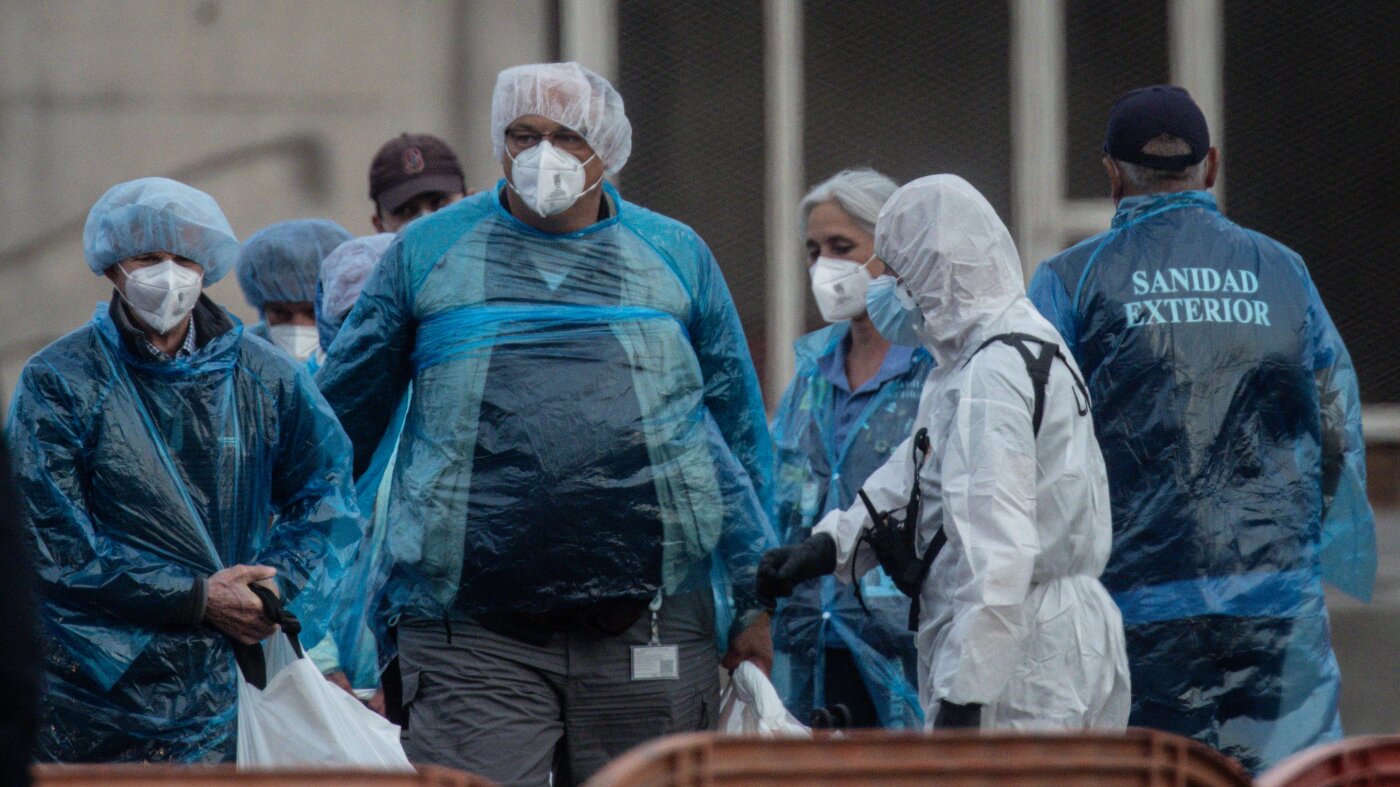
American citizens arrive onshore after being evacuated from the M/V Hondius in the Granadilla Port on Sunday in Tenerife, part of the Canary Islands, Spain.
Chris McGrath/Getty Images
hide caption
toggle caption
Chris McGrath/Getty Images
In the wake of a hantavirus outbreak aboard the MV Hondius, 17 American cruise passengers are finally set to return to the U.S. early Monday. After weeks at sea, their ordeal on this Dutch-flagged vessel, which had embarked on April 1 from southern Argentina, is coming to an end. Tragically, the outbreak claimed the lives of three passengers during the voyage.
The U.S. government orchestrated a medical evacuation for these passengers from the Canary Islands to Nebraska. According to a post by the official @HHSGov account on X, one passenger tested “mildly” positive for the virus during the flight, while another exhibited mild symptoms. These two individuals traveled in biocontainment units.
Upon arrival at Offutt Air Force Base, the majority of the passengers will proceed to the National Quarantine Unit at the University of Nebraska Medical Center (UNMC) for evaluation. The Centers for Disease Control and Prevention (CDC) indicated that specific arrangements for the symptomatic passenger remain undisclosed.
Dr. Ali Khan, dean of the College of Public Health at UNMC, remarked, “For the passengers getting off the ship, I’d say, ‘Welcome to Nebraska.’ You are coming to the premier facility in the United States, if not the world, to take care of you.”
Out of nearly 150 passengers from 23 countries, the 17 Americans have been isolating in their cabins. The World Health Organization has reported at least eight hantavirus cases, including three fatalities. In a media call, U.S. health officials emphasized that the returning passengers will be monitored for several more weeks.
Unlike the COVID-19 virus, hantaviruses, including the Andes variant responsible for this outbreak, have been under scientific scrutiny for decades. Dr. Khan noted, “We do know that you can get small clusters of disease, but in 30 years we’ve never seen any large outbreaks, so this is unlikely to become a pandemic.”
While most U.S. passengers are currently well, the CDC warns that symptoms can take up to 42 days to manifest. Khan stated, “It’s appropriate to be cautious, to monitor these people for 42 days [to make sure] they don’t get sick.”
The American passengers will undergo clinical assessments upon arrival, though not under official quarantine. Some may continue monitoring at home with daily health department check-ins. Seven other U.S. passengers are already being monitored in Texas, California, Georgia, and Virginia.
Public health experts have criticized the U.S. government’s response as disjointed and delayed. Lawrence Gostin, a professor of global health law at Georgetown University, commented, “The CDC was missing in action for quite a long time. Better late than never — but it is very late.”
Emily Hilliard, a spokesperson for the Department of Health and Human Services, refuted these claims, stating, “The U.S. government is conducting a coordinated, interagency response led by the Department of State.”
In recent developments, the CDC has activated its Emergency Operations Center, dispatched teams to the Canary Islands and Nebraska, and alerted state health departments about returning travelers. Gostin acknowledged the current efforts but highlighted the shortcomings in pandemic preparedness, emphasizing the need for improved infectious disease prevention and control strategies.
This article was originally written by www.npr.org




